|
Events and sample spaces in gambling The technical processes of games of chance stand for experiments that generate random events in casino games. Such events occur wherever the games are played, at home, in a casino or online casinos. Throwing the dice in craps is an experiment that generates events such as occurrences of certain numbers on the dice, obtaining a certain sum of the shown numbers, obtaining numbers with certain properties (less than a specific number, higher that a specific number, even, uneven, and so on). The sample space of such an experiment is {1, 2, 3, 4, 5, 6} for rolling one die or {(1, 1), (1, 2), ..., (1, 6), (2, 1), (2, 2), ..., (2, 6), ..., (6, 1), (6, 2), ..., (6, 6)} for rolling two dice. The latter is a set of ordered pairs and counts 6 x 6 = 36 elements. The events can be identified with sets, namely parts of the sample space. For example, the event occurrence of an even number is represented by the following set in the experiment of rolling one die: {2, 4, 6}. Spinning the roulette wheel is an experiment whose generated events could be the occurrence of a certain number, of a certain color or a certain property of the numbers (low, high, even, uneven, from a certain row or column, and so on). The sample space of the experiment involving spinning the roulette wheel is the set of numbers the roulette holds: {1, 2, 3, ..., 36, 0, 00} for the American roulette, or {1, 2, 3, ..., 36, 0} for the European. The event occurrence of a red number is represented by the set {1, 3, 5, 7, 9, 12, 14, 16, 18, 19, 21, 23, 25, 27, 30, 32, 34, 36}. These are the numbers inscribed in red on the roulette wheel and table. Dealing cards in blackjack is an experiment that generates events such as the occurrence of a certain card or value as the first card dealt, obtaining a certain total of points from the first two cards dealt, exceeding 21 points from the first three cards dealt, and so on. In card games we encounter many types of experiments and categories of events. Each type of experiment has its own sample space. For example, the experiment of dealing the first card to the first player has as its sample space the set of all 52 cards (or 104, if played with two decks). The experiment of dealing the second card to the first player has as its sample space the set of all 52 cards (or 104), less the first card dealt. The experiment of dealing the first two cards to the first player has as its sample space a set of ordered pairs, namely all the 2-size arrangements of cards from the 52 (or 104). In a game with one player, the event the player is dealt a card of 10 points as the first dealt card is represented by the set of cards {10♠, 10♣, 10♥, 10♦, J♠, J♣, J♥, J♦, Q♠, Q♣, Q♥, Q♦, K♠, K♣, K♥, K♦}. The event the player is dealt a total of five points from the first two dealt cards is represented by the set of 2-size combinations of card values {(A, 4), (2, 3)}, which in fact counts 4 x 4 + 4 x 4 = 32 combinations of cards (as value and symbol). In 6/49 lottery, the experiment of drawing six numbers from the 49 generate events such as drawing six specific numbers, drawing five numbers from six specific numbers, drawing four numbers from six specific numbers, drawing at least one number from a certain group of numbers, etc. The sample space here is the set of all 6-size combinations of numbers from the 49. In classical poker, the experiment of dealing the initial five card hands generates events such as dealing at least one certain card to a specific player, dealing a pair to at least two players, dealing four identical symbols to at least one player, and so on. The sample space in this case is the set of all 5-card combinations from the 52 (or the deck used). Dealing two cards to a player who has discarded two cards is another experiment whose sample space is now the set of all 2-card combinations from the 52, less the cards seen by the observer who solves the probability problem. For example, if you are in play in the above situation and want to figure out some odds regarding your hand, the sample space you should consider is the set of all 2-card combinations from the 52, less the three cards you hold and less the two cards you discarded. This sample space counts the 2-size combinations from 47. All these isolated examples are not the most representative from the respective games. They are presented as an introduction to what mathematics in games of chance means, namely particular probability models, in which probability theory can be applied to obtain the probabilities of the events we are interested in. Probability models in gambling A probability model starts from an experiment and a
mathematical structure attached to that experiment, namely the field of
events. The event is the main unit probability theory works on. In
gambling/online
gambling, there are many categories of events, all of which can be
textually predefined. In the previous examples of gambling experiments
we saw some of the events that experiments generate. They are a minute
part of all possible events, which in fact is the set of all parts of
the sample space. For a
specific game, the various types of events can
be: The complete mathematical model is given by the probability field attached to the experiment, which is the triple sample space—field of events—probability function. For any basic application in a game of chance, the probability model is of the simplest type—the sample space is finite, the field of events is the set of parts of the sample space, implicitly finite, too, and the probability function is given by the definition of probability on a finite field of events. From this definition and the axioms of a Boole algebra flow all the properties of probability that can be applied in the practical calculus in gambling. Any predictable event in gambling, no matter how complex, can be decomposed into elementary events with respect to the union of sets. For example, if we consider the event player 1 is dealt a pair in a Texas Hold’em game before the flop, this event is the union of all combinations of (xx) type, x being a value from 2 to A. Each such combination (xx) is in turn a union of the elementary events (x♣ x♠), (x♣, x♥), (x♣, x♦), (x♠, x♥), (x♠, x♦) and (x♥, x♦), all of which are equally possible. The entire union counts 13C(4, 2) = 78 elementary events (2-size combinations of cards as value and symbol). There are also applications in gambling involving events related to the long-run play, whose suitable probability models are chosen from classical probability distributions such as Bernoullian, Poisson, Polynomial, or Hypergeometric distribution. Probability calculus in gambling Probability calculus actually means to use of all the properties of the probability in order to obtain explicit formulas of the probabilities of the measured events and apply these formulas in the given circumstances for obtaining a final numerical result. The basic principle that makes the probability calculus performable in gambling is that any compound event can be decomposed into equally possible elementary events, then the probability properties and formulas can be applied to it to find its numerical probability. Besides the basic properties of probability, the formulas from the classical distributions are of great help for some complex gaming events. In most probability computations in gambling, the application of the formulas reverts to combinatorial calculus, which is an essential tool for this type of applications. The hardest task of the gaming mathematician performing probability calculus is to provide explicit formulas in algebraic form, which express the sought probabilities. Expected value The mathematical model of a game of chance involves not only probability, but also other statistical parameters and indicators, of which the expected value is the most important. In gambling, probabilities are associated with stakes in order to predict an average future gain or loss. This predicted future gain or loss is called expectation or expected value (EV) and is the sum of the probability of each possible outcome of the experiment multiplied by its payoff (value). Thus, it represents the average amount one expects to win per bet if bets with identical odds are repeated many times.
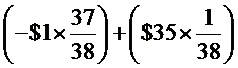
For example, an American roulette
wheel has 38 equally possible outcomes. Assume a bet placed on a single
number pays 35–to–1 (this
means that you are paid 35 times your bet and your bet is returned, so
you get back 36 times your bet). So, the expected value of the profit
resulting from a one dollar repeated bet on a single number is
The mathematical expectation
(expected value) is defined as follows: So, the mathematical expectation is a weighted mean, in the sense of the definition given above. It terms of gambling, this value means the amount (positive or negative) a player should expect, if performing same type of experiment (game or gaming situation) in identical conditions and by making the same bet, via mathematical probability. The expected value being negative is the sign for that bet being profitable for the house, by ensuring its house edge. In practice, expected value is a statistical parameter assigned to every bet that has a computable probability and a payout, even though one cannot run that bet infinitely many times. Together with probability, expected value stands as criterion for decisions in games and betting where the bets have specific payouts. The role of probability in gambling strategies A strategy only makes sense if related to both game and player. That is because it is the player who builds and applies a strategy, according to his/her own goals. Among all the criteria used within a strategy, there are subjective personal criteria related to player's profile, but also objective criteria, of which probability is the most important. Acting in a certain way in a particular gaming situation basing on the evaluation and comparison of odds/probabilities means to make a decision based on probability as the most objective measure of possibility we have. These might be decisions related to gaming situations during the game, but also of choosing a certain game or another, quitting a game for another or even not playing at all. Even objective, the criteria standing at the base of such decisions still can have a subjective component, which is the threshold of afforded risk. This parameter is an average probability to which each player refers when making decisions on his/her next action and is the level of the probability of failure with which the player is comfortable staying in the game. A general criterion using the threshold of afforded risk in a gaming strategy would be: “If the odds for my opponents (or house) to beat (gain an advantage over) me at moment t are higher than p, then I will quit (stand, fold, etc.).” The threshold of afforded risk is p and the value of p is different for each player and even can change several times during a game, for the same player. A probability-based strategy consists (and is defined as) only of decisions resulting from the evaluation and comparison of probability results. Mathematics proved that a probability-based strategy is theoretically optimal among other types of strategies, in the respect of gaining advantage during the game, at its end, and on the long-run play. There exist strategies for any game of chance, either played against with opponents or the house, and all of them can be probability-based. While in games like poker strategy includes the interaction with the opponents and applies to each round (and probability is essential in expressing the strength of a hand), in simple games like lottery or slots the only strategy is the strategy of choosing (choosing what numbers to play and how frequent to play in lottery, choosing which game to play, how many paylines to enable, and choosing not to play a particular game in slots, etc.) and this strategy can also be based on probability.
|


|