|
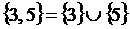
Experiments, events An experiment is a type of action that generates events. An example of an experiment is rolling the die. The performance of an experiment is called test or trial. The experiments generate outcomes (results). An experiment can have more than one outcome, while a test can have only one outcome. Example: The experiment of rolling the die can have six outcomes (namely the numbers from 1 to 6 inscribed on die’s sides). An event is an arbitrary set of pre-established outcomes of an experiment. An event can happen (occur) or not, as result of an experiment. If e is the outcome of a test and A an event related to the respective experiment, we say that A happens if e belongs to A and A does not happen if e does not belong to A. Example: In the roll of a die, the set of all possible outcomes is {1, 2, 3, 4, 5, 6}. Some events are: A = {1, 3, 5} (uneven number), B = {1, 2, 3, 4} (less than the number 5), C = {2, 4, 6} (even number). If rolling a 3, events A and B occur. Denote by Ω the set of all possible outcomes of an experiment and by P (Ω) the set of all parts of Ω. Set Ω is called the set of outcomes or the sample space of the experiment. The random events are elements of P (Ω). Operations and relations between events On the set Σ of the events associated with an
experiment, we can introduce three operations that correspond to the
logical operations or, and, non. Let A and B be
events from Σ. If A and B cannot occur
simultaneously, we say that A and B are incompatible
or mutually exclusive events and denote it by
In the set Σ of events associated with a certain
experiment, two events with special significance exist, namely, event Let A and B be events from Σ. We say
that event A implies event B and write
Definition: An event A from Example: In the experiment of rolling the
die: Boole algebras Definition: Call Boole algebra a nonempty set
A, with
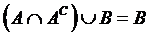
operations Axiom: The set of events associated to an experiment is a Boole algebra. Example: The set of parts P (Ω) of a nonempty set, with union, intersection and complement (related to Ω) operations, gets a Boole algebra structure. Definition: The Boole algebra of the events associated to an experiment is called the field of events of that experiment. So, the field of events is a set of parts of Ω,
structured as an algebra of events Σ, and is denoted by {Ω, Σ}.
We should retain: Read the next definitions.
|